Monday, February 28, 2011

And the Oscar Goes to...

Last night, I spent 3 hours glued to the television watching stars shine almost as brightly as their rented jewelry during the ever anticipated Oscars.  My friends and I were abuzz with outfit critiques and our own votes for who should have won and who did win... most of the time our choices were based on those we had actually heard of.  Winter's Bone, for example: not on my list.

That got me thinking, what does the Academy base their votes on?  Obviously to be part of this prestigious movie watchers' club one must go to many more movies than my teenage budget allows.  However, if I managed to see The Fighter, The Black Swan, True Grit, The Social Network, The King's Speech, 127 Hours, and Toy Story 3 (movies that seemed to run the show [it's a movie pun!!], total list of nominees HERE) I would be a very educated home-audience member. 

What set these movies apart from the other thousands produced every year?  Well, audiences receive them well... very well.  As of early February, The King's Speech made $93.9 million dollars, behind The Social Network's $96.6 million, even still behind The Black Swan which made $99.4 million (Report from LA Times).  I know that the Academy does not vote for the highest grossing film, or else there would be a different list of winners than was announced last night. 

What then, constitutes a winner? 

One must first apply to be considered for an Oscar, and meet THESE qualifications, for example must have played in Los Angeles and must meet certain filming requirements.   This year, the Academy accepted submissions from THIS list.  Those who apply are judged by an Academy of 600 members in the film industry.   Ethics and fairness are also emphasized:
"The Awards competition is a process that requires the voting members of the Academy to make their choices based solely on the artistic and technical merits of the eligible films and achievements"
So it seems that when I suspect movies win awards for having a decorated director or lead actor, I was assuming too much.  The Oscars are legitimate: they measure artistic merit, not financial.  That makes me feel a little better about supporting Hollywood; this part at least.  Don't get me started on spray tans...

Some pictures from last night's event:


Monday, February 21, 2011

TV Tokenism

In class today, Mr. O'Connor and Mr. Bolos recapped their experience on the recent CASE conference.  They told us a little bit about TV Tokenism, which is, according to the always reliable dictionary.com, doing the absolute minimum.  In regards to television, this means the minimal amount of diversity in casts of characters. 

Mr. Bolos told us to think about the nature of Network Dramas.  I am a reality TV junky, so I do not know much about the hour long programs on public networks.  After a little digging, I found some popular shows as depicted by the NY Times.   The first show on their list and my point of focus: Law and Order. 

A brief synopses, for you and I both...
It has been running on NBC for 20 seasons and has different "versions," including Special Victims Unit (SVU).  The first half-hour of the show is dedicated to Law and takes place at crime scenes, and the second half focuses on the Order in a court room.  For a more complete description and for credits, please click HERE.

The main character, as TV Tokenism ensures, is a white male.  His colleagues are mainly white as well, with the exception of two Black cast members.  Click HERE for bios, and please note that Sam Waterston's biography appears upon opening the "Bios" tab; I did not click it.  It is a sad truth that even in this dynamic and arguably progressive society, the main character of one of the longest running Network Dramas is a white male.  Previous protagonists include others that fit the same bill: pale skin, grey hair, male, and over 50.

To say that Law and Order represents all Network Dramas in this sense would be over-simplifying, but to say it is unique would do the same.  Next time you are watching House or 24, for example, take note of the nature of the characters, and of which characters are not present.

Monday, February 14, 2011

Spread the Love, Stop the Hate

The Civil War ended in 1865.  In 2011, 146 years later, it still impacts us.  CNN reported HERE on the "Sons of Confederate Veterans" who want to honor a KKK leader from the Civil War through a licence plate.  The NAACP (of Mississippi) has asked the Governor to deny this proposal, as it is clearly offensive.
Among the many questions this brought to my mind, one was strongest: Why?  Why would anyone want to honor a terrorist?  I can only imagine: hate.  Hate has long existed in the world, and will unfortunately continue to exist.  Currently in the US, there are about 5,000 Klansmen.  (Stats about the KKK).  I am still struggling to understand... how can there even be one?!?! 

Their hate makes me angry and disappointed, so I'll protest it.  Instead of dwelling on their hate, and especially because it is Valentine's Day, I'm going to spread the love.  Some lovely things that have changed since 1865...

*Women accounted for 51 percent of all workers in the high-paying management, professional, and related occupations in 2009(click HERE for more stats)
*We have a Black President, Barack Obama
*Public High School graduation rates are expected to increase (click HERE for more stats)
*Life saving medical advancements continue to be made all the time (click HERE for timeline)

So, to you SCV out there, I hope you realize your failings soon, as they are most certainly failings.  To everyone else, even if you cannot change other people's views, change yours.  Not just between white and black, but between among all races, religions, sexualities, mental, and physical abilities: there is still work to be done.  We can do it; educate yourself and change what you don't like.  Hope this blog post helps a bit.

Wednesday, February 9, 2011

The Wheels on the Bus Spin Round, and Round, and Round

In 1883, the Civil Rights Act  of 1875, which segregated trains, hotels, and other public spaces, was ruled unconstitutional (a national law).  Almost 100 years later, Rosa Parks was arrested for refusing to give up her seat on a public bus to a white passenger on December 1, 1955.  Local ordinances in Montgomery allowed the bus driver to assign seats and thus not comply with Constitutional law.  Thus, she was arrested and ignited the over year long Montgomery Bus Boycott.

As discussed in class, local law often acts as a loophole to federal law.  Rosa Parks, according to federal law, committed no crime (as the court later ruled).  However, the people of Montgomery needed to protest public buses to earn a right that was actually already theirs.  Odd?  Well, yeah!  Racism is odd!

Foner tells of such protests far before the 1950s: "Hundreds took part in sit-ins that integrated horse drawn public streetcars in cities across the South" (544).  Even though hundreds of people in the 1800s protested, 100 years later thousands of African Americans carpooled, walked, or biked to work in order to not ride busses.  The struggle was long and hard, and yet, the 14th amendment protected them all along.  It states: "No State shall make or enforce any law which shall abridge the privileges or immunities of citizens of the United States."  Obviously, this amendment was not properly upheld from the time of its publication and people suffered for it.  History proves that laws do not always protect people when hatred abounds.


Thanks, Rosa, for fighting for what was yours.  I'm sorry the fight was necessary.  


Rosa Parks in 1955 after refusing to give up her seat on a public bus.  She was not the first in her fight for recognition of  her Constitutional right of equality as a citizen.


Thursday, February 3, 2011

Black History Month: 365 Days Long

On the AIS class website, a quote is displayed..."I liken having a Black History Month in February and concentrating study on that to milk that's just about to spoil. You can still drink it, but it just doesn't taste right." -Philip Roth, The Human Stain

I did a little more digging on the topic, and found what seemed to be a similar idea presented by the NAACP (National Association for the Advancement of Colored People):  "We should emphasize not Negro History, but the Negro in history. What we need is not a history of selected races or nations, but the history of the world void of national bias, race hate, and religious prejudice."- Dr. Carter G. Woodson on the founding Negro History Week, 1926

Mr. Roth and Dr. Woodson make the same claim: celebrating during a certain time actually creates more separation. It "just doesn't taste right" to separate American accomplishments into racial categories.  What do you think?  Is it better to not have a Black History Month and not look at accomplishments in black and white, or celebrate African Americans specifically for an entire month?

Sunday, January 30, 2011

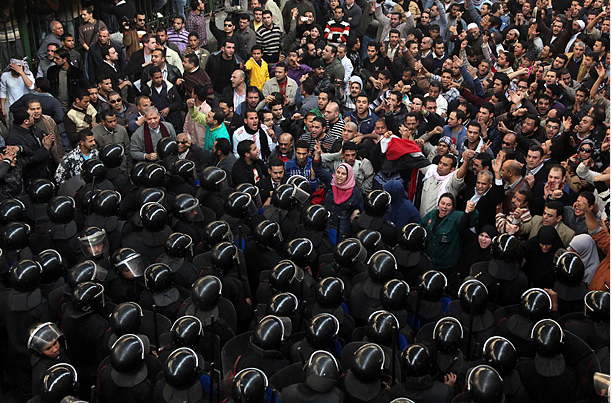
Good guys and bad guys... an editor's perspective on Egypt


Editing can make all the difference, as shown in the pictures above.  The "peaceful" protestors are seen here, confronted by the faceless antiriot police.   I do not know much about this, but at first glance, it seems that the police are like robots.  They have no faces and come in rows, like machine work.  The people, women and men alike, are colorfully clad and unarmed.  To the eye untrained by AIS, this picture is a fully true depiction.  It's a clear picture, right?

Well, it's more complicated than that.  I looked closely at the "good guys" and zoomed in.  The seemingly all good civilian force is more diverse than that.  Please refer to the pictures above.  The left, a woman in pink, is asking for peace.  On the right, a woman in the same "good" crowd, stands close fisted and seemingly yelling.

Even though I do not know the full story of what is going on in Egypt, I know it is complicated.  Not everyone on the "peaceful" side is all that peaceful, and I cannot believe that the police are ruthless.  My thoughts are with ALL those impacted by the goings on in Egypt.  TIME reports via photoessay at http://www.time.com/time/photogallery/0,29307,2044357,00.html.  Let me know if you find any more subtle details from these photos.

Monday, January 17, 2011

In Honor of Dr. Martin Luther King, Junior

An inspirational man is honored today.  More than a day off of school, today is a day for reflection.  A Metablog post on a grand scale, to put it simply, occurs every year on the third Monday of January.  Here we see the dream he dreamt in 1963 in front of 250,000 people in Washington, D.C.


For more information on this inspirational human being, please refer to his biography from the Nobel Peace Prize, of which he won in 1964.  Here is the article.  One passage that struck me:
In the eleven-year period between 1957 and 1968, King traveled over six million miles and spoke over twenty-five hundred times, appearing wherever there was injustice, protest, and action; and meanwhile he wrote five books as well as numerous articles
Even if you are busy, please make time today, or any day you have the chance, to pay homage to the man with a dream.  If you would like to learn more, I found these links very informational:

-While in jail in 1963 for violating an Alabama law, he wrote this letter: Letter From a Birmingham Jail
-PBS' page on MLK, includes a feature film, interviews, maps, and more: Citizen King
-Founded by his wife, Correta Scott King, a "living memorial": The King Center